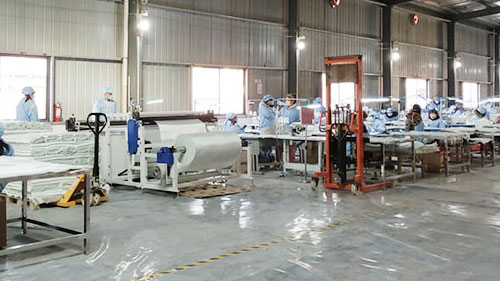
How to Choose a Reliable PTFE Fiberglass Fabric Manufacturer
Overview:Learn how to choose a reliable PTFE fiberglass fabric manufacturer. Key factors include coating quality, raw materials, certifications, customization, and quality control.
In industrial applications such as conveyor belts, heat sealing, insulation jackets, and release liners, PTFE fiberglass fabric plays a critical role in performance and durability. However, the quality of the final product depends heavily on the manufacturer behind it.
Choosing the right supplier is not just about price — it is about coating technology, raw materials, process control, and long-term reliability.
This guide will help you evaluate and select a trustworthy PTFE fiberglass fabric manufacturer.

What Is PTFE Fiberglass Fabric?
• Excellent non-stick properties
• High temperature resistance (up to 260°C continuous)
• Chemical resistance
• Low friction coefficient
• Superior dimensional stability
It is widely used in food processing, packaging, textile, electronics, and industrial manufacturing.

1. Evaluate Raw Material Quality
Key Points to Check:
• Fiberglass base fabric grade (E-glass quality, yarn count, weaving density)
• PTFE dispersion purity
• Stable supplier sources
• Material certification (RoHS, REACH, FDA if food-grade)
Low-grade fiberglass or diluted PTFE will result in poor coating adhesion, reduced lifespan, and inconsistent thickness.
Ask for technical data sheets (TDS) and material safety data sheets (MSDS).

2. Assess Coating Technology & Production Capability
Important Manufacturing Factors:
• Multi-stage coating and drying process
• Precise temperature control systems
• Uniform tension control during coating
• Calendering process for smooth surface finish
Professional manufacturers usually have:
• Automatic coating lines
• Digital thickness monitoring
• Experienced technical engineers
Uneven coating may cause cracking, peeling, or weak non-stick performance.
3. Verify Technical Specifications Transparency
• Total thickness
• PTFE coating percentage
• Weight (g/m²)
• Tensile strength (warp & weft)
• Temperature resistance range
• Dielectric strength (if applicable)
If the supplier cannot clearly explain coating weight or tolerance control, this is a red flag.
4. Check Customization Capability
For example:
• Food industry → FDA-compliant PTFE
• Packaging industry → High release performance
• Textile industry → High tensile strength
• Electronics → Anti-static properties
Reliable manufacturers should offer:
• Custom thickness (0.08mm–1.0mm+)
• Custom PTFE coating weight
• Anti-static versions
• Adhesive-backed versions
• Belt fabrication services
OEM capability is essential for brand owners and distributors.
5. Inspect Quality Control System
A reliable PTFE fiberglass fabric manufacturer should conduct:
• Thickness testing
• Tensile strength testing
• Adhesion testing
• Surface inspection
• Heat aging tests
Ask whether they provide batch inspection reports.
ISO certification is also a positive indicator.
6. Review Export Experience & Industry Reputation
• International packaging standards
• Logistics requirements
• Documentation compliance
• Market-specific certifications
Check:
• Export regions
• Customer case studies
• Years in operation
• Online presence & reviews
Long-term clients are usually a sign of stable quality.
7. Compare Price Rationally — Not Blindly
• Fiberglass weight
• PTFE coating ratio
• Thickness tolerance
• Production scale
Extremely low prices often indicate:
• Lower PTFE content
• Reduced coating passes
• Thinner fiberglass base
• Inconsistent quality
A reliable manufacturer provides transparent cost explanation rather than unrealistic quotations.
8. Request Samples Before Bulk Orders
• Surface smoothness
• Release performance
• Heat resistance
• Flexibility
• Coating adhesion
Practical testing prevents large-scale risk.
Final Checklist Before Choosing a Manufacturer
✔ Clear technical documentation
✔ Stable raw material sourcing
✔ Advanced coating production line
✔ Strict quality control
✔ Customization capability
✔ Export experience
✔ Transparent pricing
Conclusion
• Stable product quality
• Long service life
• Reduced operational risk
• Competitive advantage in your market
Do not focus solely on price — focus on technology, process control, and long-term partnership capability.
If you are sourcing PTFE fiberglass fabric for industrial, food-grade, or high-temperature applications, working directly with an experienced manufacturer ensures better performance and stronger supply stability.